
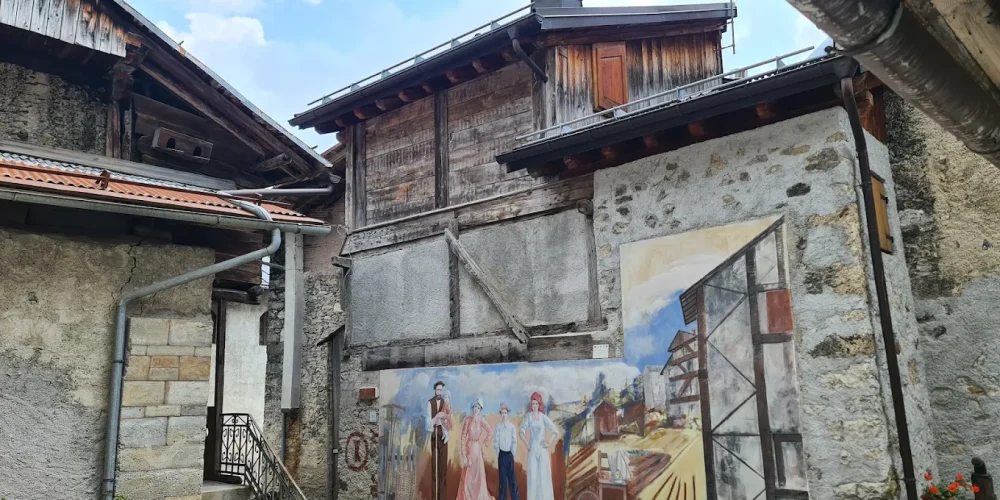
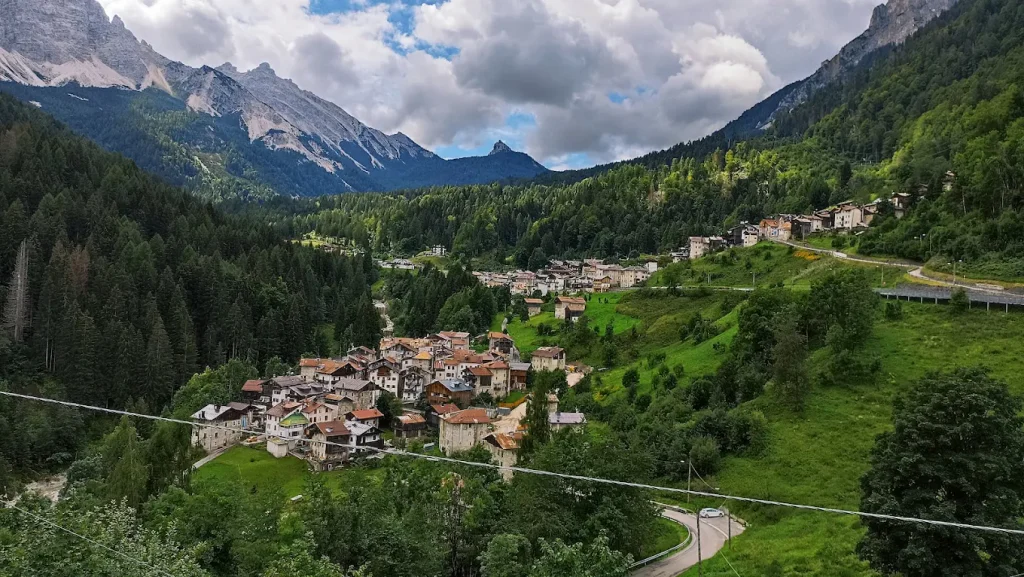
Cibiana di Cadore is a small mountain village of about 320 residents, located in a side valley above the Boite. On the walls of its old stone and timber houses, there are more than 60 paintings.
Together, the Murales Cibiana dì Cadore tell the story of the village.
This guide explains how the murals started, which ones to look for, how to walk the village, what’s going on with Monte Rite and the Messner Museum this year, and the practical details for getting there and eating well.
What is Cibiana di Cadore, and why is it called the village of murals?
Cibiana sits at around 985 m, a few kilometres up the road from Venas di Cadore towards the Passo Cibiana (1,530 m), which links the Boite valley with Val di Zoldo.
The village is spread across a handful of hamlets, including Pianezze, Masariè and Cibiana di Sotto, and the murals are scattered between them.
- Murals: more than 60, with new ones added most years
- Artists: roughly 120 Italian and international painters have taken part
- Started: 1980
- Cost: free, open all year
- Time needed: about 1 hour 20 minutes on foot for the full loop
How the Murales Cibiana dì Cadore began: history and cultural roots
For centuries, Cibiana lived off iron. Ore from the Ronzei and Vallinferna mines fed a tradition of fine metalwork, and by the 18th century the village had become known for hand-forged keys. That craft survives today through Errebi, a local key manufacturer.
The mines eventually closed, and emigration, first to the Americas and then to northern Europe after the Second World War, slowly emptied the village.
The mural project was a response to that.
The idea came from Osvaldo Da Col, a local man who had returned from working in Germany, with the support of his friend, the painter Vico Calabrò.
The first two works went up in 1980, and the project has grown ever since. Early painters came mostly from the Veneto, but over time artists from across Europe, Russia, and Japan joined in.
Which murals should you see in Cibiana di Cadore?
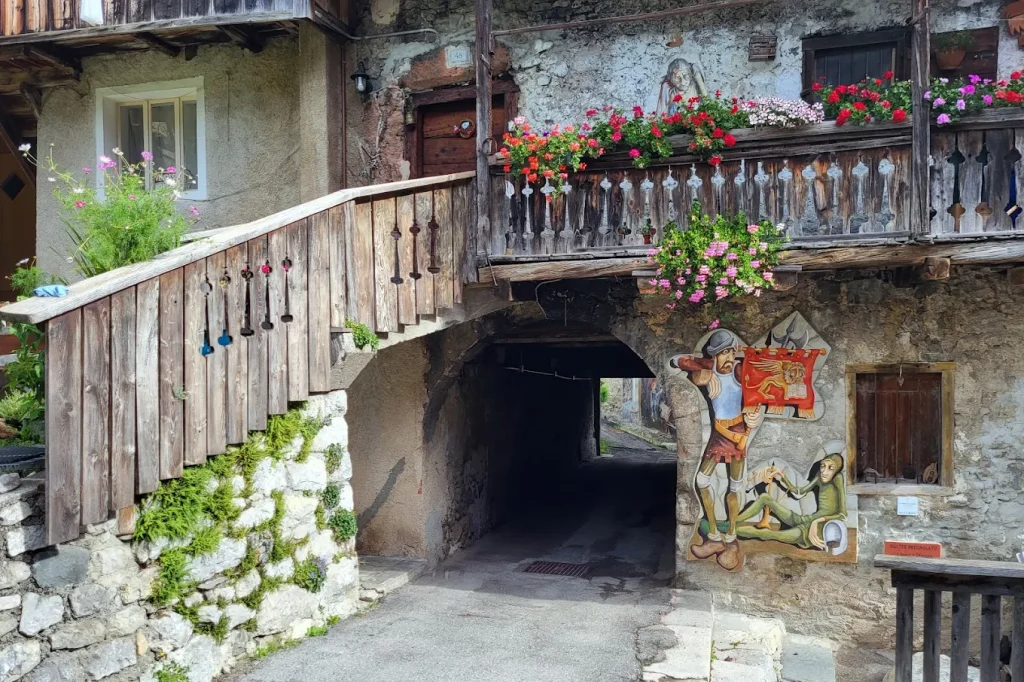
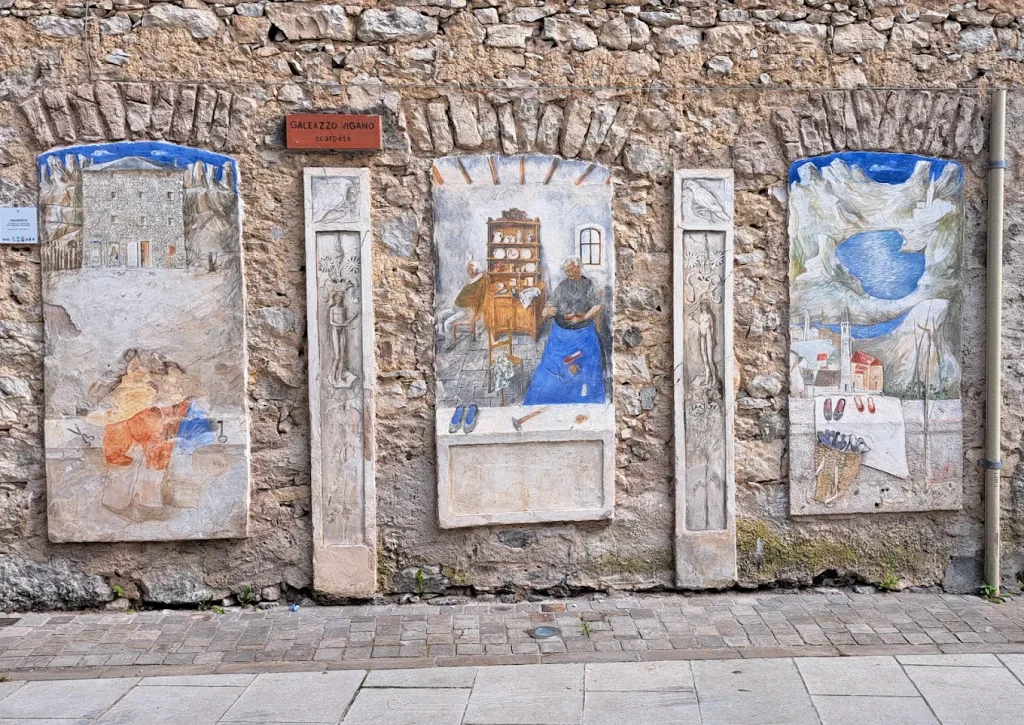
Each of the Murales Cibiana dì Cadore carries a title in the local dialect, usually naming the trade or story of the family who lived there.
| Mural | Artist | Year | What it shows |
|---|---|---|---|
| Al squadrador | Aldo De Vidal | 1980 | A craftsman squaring timber beams, one of the first two murals |
| Letra da lontan | Giuliano De Rocco | 1980 | A family reading a letter from relatives who emigrated to Argentina |
| Al moliner | Luigi Rincicotti | 1981 | The village miller |
| La botega | Bruna Doria | 1982 | The village shop, once the centre of daily life |
| L’Alviano and La vecia | Walter Pregnolato | 1982 | The 1508 battle in which Bartolomeo d’Alviano drove back Emperor Maximilian’s troops |
| La storia de la anguana | Geoffrey Humphries | 1989 | The anguana, a water spirit from Alpine folklore |
| Al torna de la fedes | Carmelo Zotti | 1989 | A shepherd bringing his flock home |
| La forgia | Sergio De Bon | 1998 | The forge and the village’s iron-working past |
How to explore Cibiana di Cadore on foot: route and tips
The usual starting point is Pianezze, with the tourist information office in Cibiana di Sotto. From there, a loop of about 1 hour 20 minutes takes you through the hamlets on quiet lanes and steps.
Must-do checklist:
- Pick up a map of the murals at the tourist office
- Find the two 1980 originals, “Al squadrador” and “Letra da lontan”
- Read the dialect titles and guess the trade before reading the caption
- Wear shoes with grip for the steeper lanes
- Respect residents’ privacy, as these are lived-in homes
Monte Rite and the Messner Mountain Museum: what to know in 2026
Above the village rises Monte Rite (2,181 m), where an Italian army fort built just before the First World War was turned into the MMM Dolomites museum by the climber Reinhold Messner.
It opened in 2002 and became known as the “museum in the clouds”, with paintings of the Dolomites and a 360-degree view taking in peaks such as the Pelmo, Civetta and Monte Antelao.
Important notice: Check before you go, though. A dispute between Messner and the municipality of Cibiana forced the museum to close for the entire 2026 season, the first time in 24 years, and led to the suspension of the summer shuttle service up the mountain. The new mayor has said he wants to reopen talks, so watch for news on the 2027 season.
The hike itself is still a good day out. From Passo Cibiana, a former military road climbs about 7 km and roughly 650 m to the summit, which takes 2 to 2.5 hours on foot.
Getting to Cibiana di Cadore: directions, parking and where to eat
| From | Route |
|---|---|
| Cortina d’Ampezzo and Borca di Cadore | Head south on the SS51 Alemagna to Venas di Cadore, then turn up the SP347 |
| Pieve di Cadore | Head north on the SS51 to Venas, then the SP347 |
| Val di Zoldo | Over the Passo Cibiana from Forno di Zoldo, about 10 km of climbing |
| Public transport | Limited, so a car is by far the easiest option |
Parking is limited in the narrow lanes, so leave your car in the small spaces near the hamlets’ entrances and walk the rest of the way.
Try local Cadore dishes such as canederli, local cheese and cured meats, and Pastin di Zoldo.
Plan your trip to Cibiana di Cadore with D4U
The Murales Cibiana dì Cadore are a reminder that the Dolomites aren’t only about mountain peaks. Spend a morning reading the walls, have lunch in the old hay barn, and if your legs are willing, take the old military road up Monte Rite in the afternoon.
D4U has holiday homes across the valley, so you can base yourself close to the village and spend the rest of the week in the wider Cadore area.
Discover our Cadore apartments and chalets and choose the one that fits your needs, whether that’s a quiet village flat or somewhere with room for the whole family.
Book your mountain escape today with D4U.


